
MATERIALS
PVC
Excellent Stiffness, flame resistance, weather resistance, dimensional stability, and chemical inertness. PVC is appropriate for pipelines, medical devices, outdoor appliances, and electrical insulation.
Precision Parts. Endless Possibilities.
Explore our custom manufacturing capabilities through real product examples.
















PVC At a Glance
| Process compatibility | Applications | Subtypes | Tolerances | Wall Thickness | Max Part Size | Strengths | Lead Time | Price |
| CNC Mill CNC Lathe |
Electrical conduits, medical tubing, automotive trim, signage, industrial piping, valves and fittings | Rigid PVC (uPVC) High Impact PVC CPVC (Chlorinated PVC) Flexible PVC |
Not lower than ±0.125mm (±0.005″) based on the drawing ( ISO 2768) | Minimum 0.80 mm (0.03″), but this can change depending on the proportion of the wall thickness to the linear dimension. | 200 x 80 x 100 cm | Excellent chemical resistance, low water absorption, electrical insulation and self-extinguishing flame retardancy. | Minimum 3 days. Not more than 10 days; for all complex parts. | $ |
Introduction to PVC
PVC is a lightweight, corrosion-resistant manufacturing material with excellent tensile strength, rigidity, weather resistance, flame retardant, and chemical inertness.
It offers a range of beneficial material qualities, including dimensional stability, vapor barrier performance, electrical insulation, and manufacturing versatility.
For many applications, including pipe, electrical insulation, food and chemical processing, and outdoor appliances, PVC is the cost-effective and long-lasting choice.
Unmatched Precision in Prolean PVC CNC Machining Services
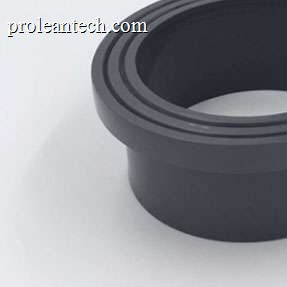
Prolean CNC machines rigid PVC (uPVC), high-impact PVC, CPVC and flexible PVC on CNC mills and lathes. PVC is softer than metals and has a low melting point, so it is cut with sharp, high-rake carbide tooling, controlled feed rates and generous cooling — the material is sheared rather than melted or smeared, which is what keeps edges clean and thin walls dimensionally stable.
Rigid PVC holds tolerances well and resists acids, bases and salts, which is why it is widely used for fluid-handling and electrical components. Flexible PVC grades are more elastic and need lighter clamping and softer work-holding to avoid deformation. Where a smoother surface is required, parts can be sanded or polished after machining, and PVC can be glued, welded or mechanically fastened.
Excelling in Custom PVC CNC Machining for Diverse Applications
PVC is one of the most cost-effective engineering plastics, and CNC machining turns it into precise, repeatable components across a wide spread of industries:
- Electrical — conduits, boxes and insulators, where PVC’s dielectric strength and volume resistivity do the work
- Medical — containers, tubing and equipment housings
- Automotive — interior trim, dashboards and cable insulation
- Signage and displays — lightweight, weather-resistant panels with intricate profiles
- Industrial piping — pipes, valves, flanges and fittings for chemically aggressive media
Typical parts include bushings, spacers, covers, manifolds and fluid-handling components. For the full material background — grades, properties and machining parameters — see What is CNC Machining of PVC?
Cost-Effectiveness in PVC CNC Machining Services
PVC stock is inexpensive and machines quickly, which keeps both material and cycle time low. The price of a machined PVC part is driven by five things: part size and complexity, the machining method (milling or turning), the tolerance class required, the surface finish specified, and the order quantity — bulk runs lower the cost per unit, while one-off prototypes carry more setup per part.
Because PVC is soft and free-cutting, it usually needs fewer finishing operations than metals, which is one reason it is a common choice for enclosures, spacers and fluid-handling hardware. Send us your drawings and we will quote the design as-is, with DFM feedback on anything that adds cost without adding function.
PVC CNC Machining with Global Expertise and Instant Online Quotes
Global buyers can get an online quote for PVC CNC machining without leaving the site. Upload your drawings, tell us the quantity and finish, and we will come back with pricing, lead time and DFM notes.
All uploads are secure and confidential. If a design needs a tweak before it can be machined cost-effectively, we will tell you before the job starts.
Latest Blog
Check out our latest blogs, we share industry trends, design tips, and experience earned from manufacturing.
- Electroplating Vs Electro-less plating
- What are the types of surface finishes for CNC machining?
- Common Materials for CNC Machining
- Tolerances in CNC Machining
- Sheet Metal Fabrication: Enclosures for Electronics
- Best Cutting Tools for CNC Machining– Choose the Right
- An Ultimate Guide to CNC Copper Machining
- Production Cycle Time in CNC Machining
- Electroplating Vs Electro-less plating
- What are the types of surface finishes for CNC machining?
- Common Materials for CNC Machining
- Tolerances in CNC Machining
- Sheet Metal Fabrication: Enclosures for Electronics
- Best Cutting Tools for CNC Machining– Choose the Right
- An Ultimate Guide to CNC Copper Machining
- Production Cycle Time in CNC Machining

Die Cast Industry: Status in 2026 and Trends by Segments
Die-casting is a process of creating metal components by forcing molten material into a reusable mold (called a die), where it fills the cavity and takes the shape upon solidification.
Read more →
Electric Discharge Machining Applications Across Industries
Electrical Discharge Machining (EDM) is a non-conventional subtractive manufacturing process, in which a tool (electrode/wire) removes the material from conductive workpieces using controlled electric sparks inside a dielectric medium
Read more →
PEI CNC Machining: Material Grades, Processes, and Considerations
PEI CNC machining converts raw PEI rod, bar, or plate into functional components using cutting, milling, turning, drilling, and other suitable operations using the CAD model & CNC program.
Read more →PVC MATERIAL DATA
Specify rigid/flexible formulation, service media and joining method
PVC is not one material state: rigid and flexible formulations, additives and service environment affect how the component performs. Define the selected formulation, chemical exposure, temperature range, joining method and the geometry that governs assembly or flow.
Engineering data to lock before release
| Formulation | Rigid/flexible grade, color and intended standard |
|---|---|
| Service data | Fluid, temperature, pressure or electrical environment |
| Fabrication data | Machining, bonding, welding or fastening requirement |
| Verification | Critical dimensions and applicable functional test |
The compound and service media must be identified together; a generic PVC designation cannot establish chemical compatibility.
