
MATERIALS
Polyetherimide (PEI)
Semi-transparent, high strength, rigidity, thermal stability, chemical inertness, and dimensional stability. Parts made from PEI can work for an extended period without stress cracking.
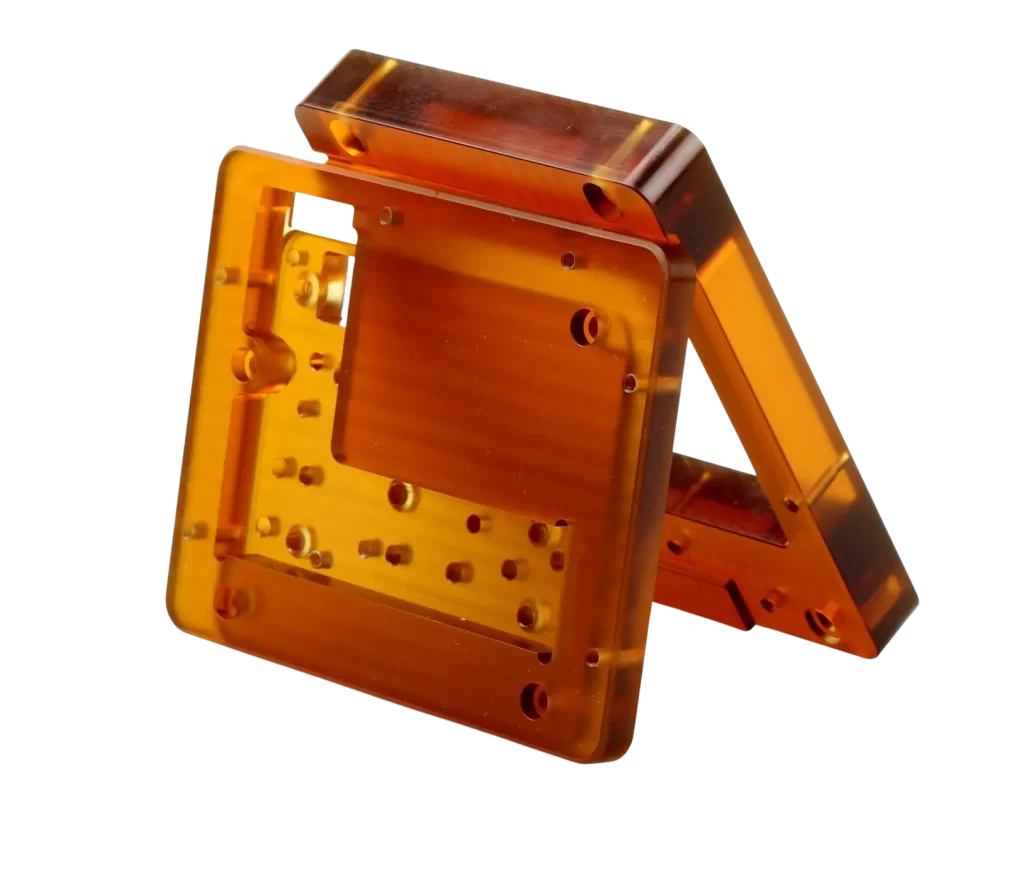
Precision Parts. Endless Possibilities.
Explore our custom manufacturing capabilities through real product examples.
















Polyetherimide (PEI)(ULTEM)
| Process compatibility | Applications | Tolerances | Wall Thickness | Max Part Size | Strengths | Lead Time | Price |
| CNC Mill CNC Lathe |
Voltage breakers, carburetor housings, microwave housing, medical, chemical instruments, and aerospace parts. | Not lower than ±0.25 mm (±0.010″), based on the drawing ( ISO 2768) | Minimum 0.03″ (0.80 mm), but this can change depending on the proportion of the wall thickness to the linear dimension. | 200 x 80 x 100 cm | Semi-transparent, high mechanical strength, rigidity, thermal stability, and chemical inertness. | Minimum 3 days. Not more than 10 days; for all complex parts. | $ |
Introduction to Polyetherimide (PEI)
PEI provides a high degree of creep resistance, weather stability, chemical resistance, Stiffness, stress cracking resistance, Dimensional stability, and fair electrical conductivity.
Because of these flexible properties, It is suitable for fabricating voltage breakers &carburetor housings, microwave housing, medical and chemical instruments, aerospace parts, and many more.
Latest Blog
Check out our latest blogs, we share industry trends, design tips, and experience earned from manufacturing.
- Electroplating Vs Electro-less plating
- What are the types of surface finishes for CNC machining?
- Common Materials for CNC Machining
- Tolerances in CNC Machining
- Sheet Metal Fabrication: Enclosures for Electronics
- Best Cutting Tools for CNC Machining– Choose the Right
- An Ultimate Guide to CNC Copper Machining
- Production Cycle Time in CNC Machining
- Electroplating Vs Electro-less plating
- What are the types of surface finishes for CNC machining?
- Common Materials for CNC Machining
- Tolerances in CNC Machining
- Sheet Metal Fabrication: Enclosures for Electronics
- Best Cutting Tools for CNC Machining– Choose the Right
- An Ultimate Guide to CNC Copper Machining
- Production Cycle Time in CNC Machining

Die Cast Industry: Status in 2026 and Trends by Segments
Die-casting is a process of creating metal components by forcing molten material into a reusable mold (called a die), where it fills the cavity and takes the shape upon solidification.
Read more →
Electric Discharge Machining Applications Across Industries
Electrical Discharge Machining (EDM) is a non-conventional subtractive manufacturing process, in which a tool (electrode/wire) removes the material from conductive workpieces using controlled electric sparks inside a dielectric medium
Read more →
PEI CNC Machining: Material Grades, Processes, and Considerations
PEI CNC machining converts raw PEI rod, bar, or plate into functional components using cutting, milling, turning, drilling, and other suitable operations using the CAD model & CNC program.
Read more →PEI MATERIAL DATA
Define grade, heat exposure and the dimensions that must remain stable
PEI parts are usually chosen for elevated-temperature, flame or stiffness requirements. Make the service temperature, grade/filled condition, chemical exposure, tolerance-critical interfaces and required documentation explicit before selecting stock or moulding route.
Engineering data to lock before release
| Material identity | PEI grade, reinforcement and stock/moulded form |
|---|---|
| Thermal requirement | Exposure profile and dimensional-stability concern |
| Interface data | Mating features, inserts and load path |
| Acceptance evidence | Certificate, dimensions and specified test reports |
Temperature and processing history affect polymer behavior; acceptance limits should refer to the intended grade and condition.
